
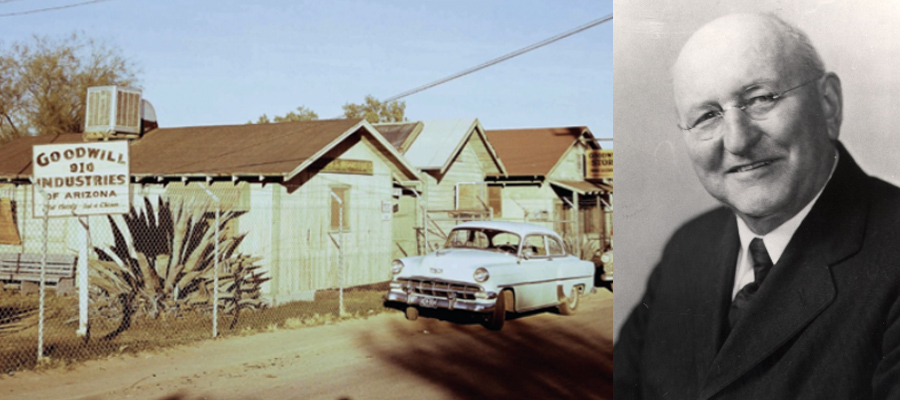
Goodwill was founded in Boston, MA, in 1902 by Rev. Edgar J. Helms. It was Rev Helms’ vision to end poverty through the power of work, and so he began collecting donated goods from his local community with the intent to sell those donated goods for profit, and then use the money to pay the workers who helped refurbish them.
“The Goodwill Industries should not only save the waste in men and things but ought also to use the waste. How little we receive from wastepaper, rags, etc., because we collect it only and do not convert it into useful things.
-Goodwill Founder Reverend Edgar J. Helms, 1922
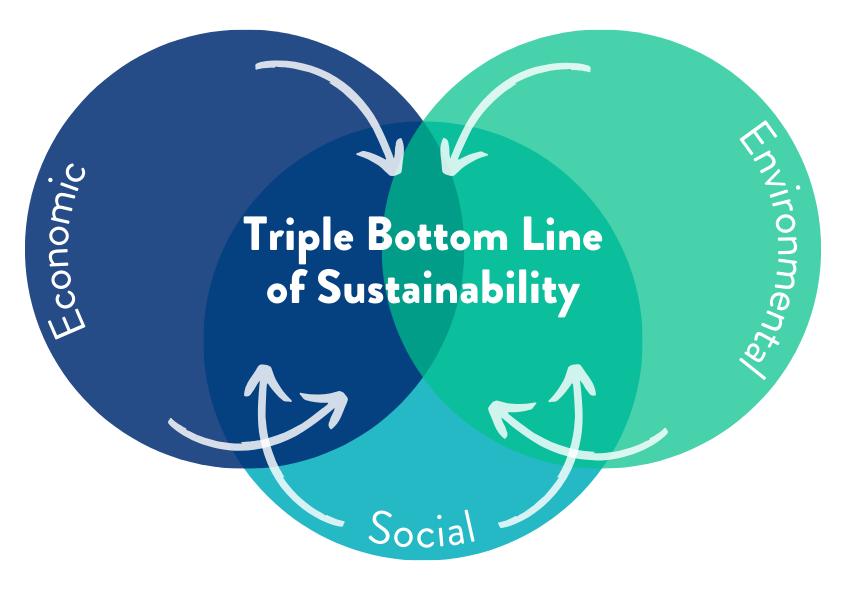
The triple bottom line is an economic concept that expands a typical business model from focusing only on profits to include social and environmental impacts. Goodwill’s model brings the triple bottom line to life: advancing people, planet and purpose-driven revenue into the business functions. Here’s how:
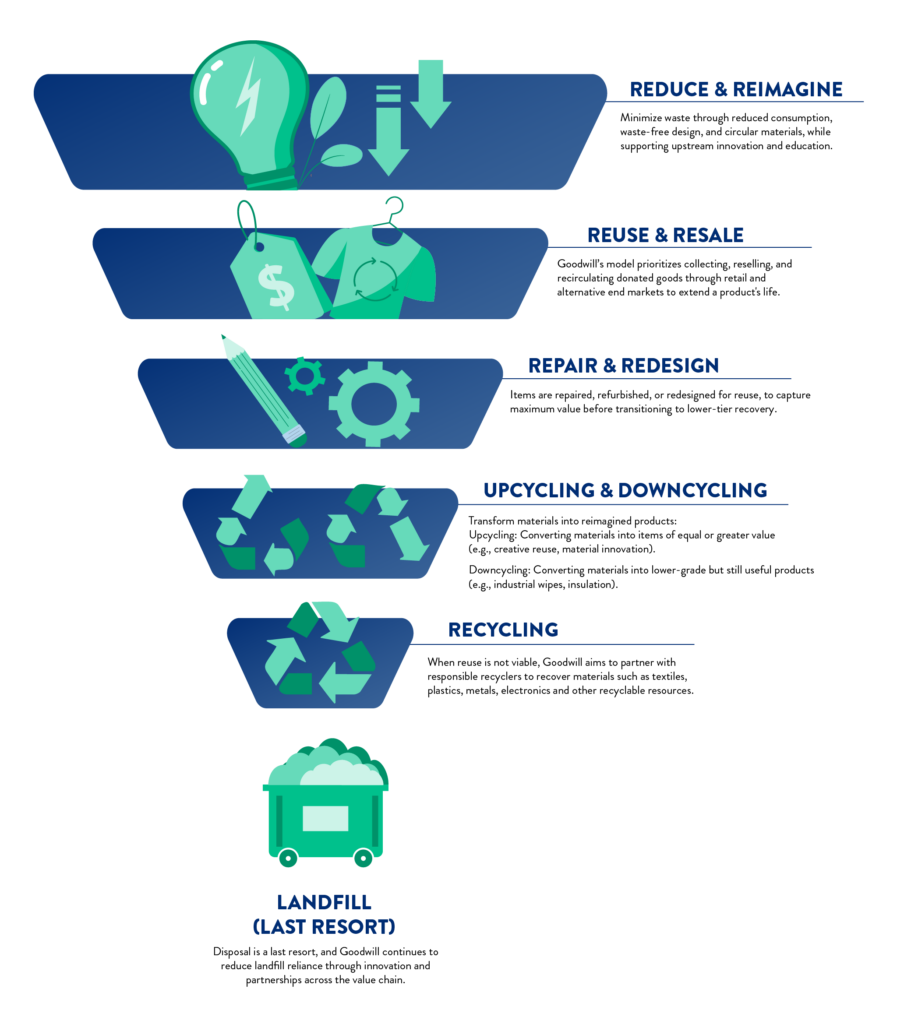

The traditional thrift model has historically been to “collect, sell, and salvage” donated goods. Goodwill of Central and Northern Arizona is working to change this model by identifying responsible, alternative end markets for every item donated in an effort to recapture valuable resources and divert materials from landfills.
At Goodwill of Central and Northern Arizona, reuse is at the core of what we do. Guided by the zero-waste hierarchy, we prioritize reuse first and are launching new initiatives to help the Grand Canyon State recycle, repurpose, and reimagine what’s possible when sustainability comes first.
And it all starts with your donations.
While not every item is designed for reuse, we partner across the value chain to develop circular, traceable, and scalable solutions that extend the life of materials and maximize their impact.
Currently, an estimated 11.3 million tons of textile waste – equivalent to 85% of all textiles – end up in landfills annually in the United States. Meanwhile, over 80% of plastics used in the United States end up in landfills yearly.
GCNA is focused on solutions for unusable plastics and textiles to:
Together, we are committed to reducing the materials we send to landfills while driving workforce, education, and economic impact in our community.
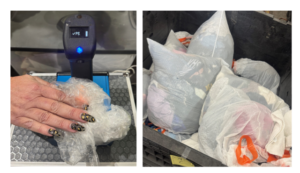
GCNA has designed a multi-phase pilot to establish a scalable, closed-loop recycling solution for post-consumer plastic film that establishes viable collection, sortation, processing, and end-market pathways. The multi-phase project is designed to innovate and incubate in Arizona at GCNA’s distribution center and retail network and scale to other regional Goodwill partners.
GCNA received funding from the Dow Business Impact Fund to launch Phase 1 of this project, GoodFlex.
Article: Dow uses collaboration, know-how to push change

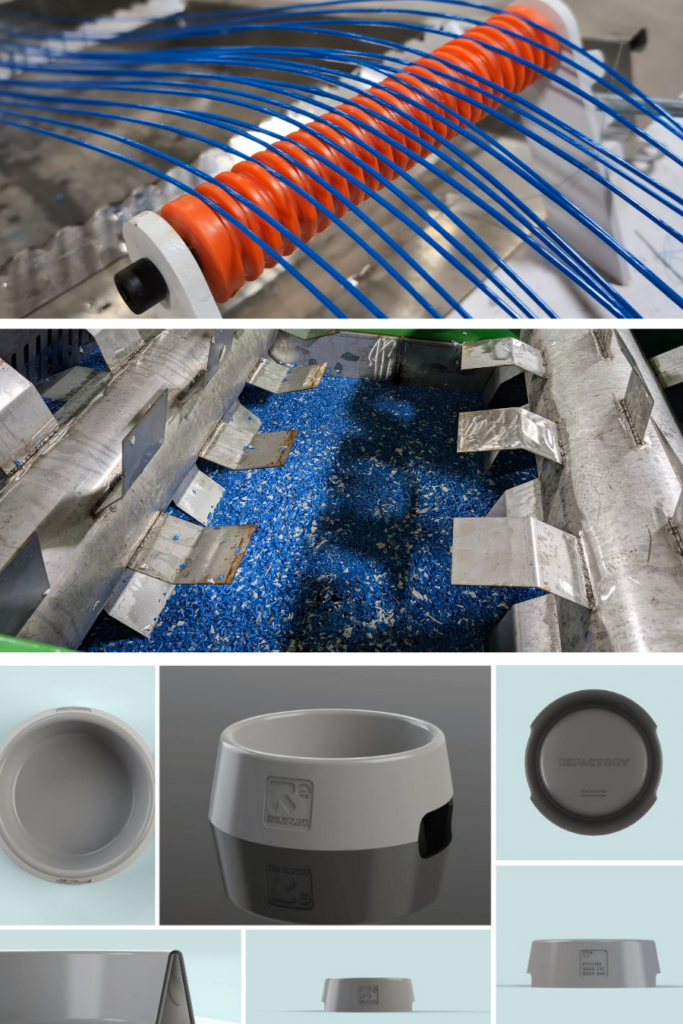
The Circular Plastics Microfactory is a first-of-its-kind approach to material recovery and remanufacturing, rethinking how discarded materials are collected, processed, and transformed into new products. Developed in partnership between Arizona State University and Goodwill of Central and Northern Arizona, the microfactory reimagines the recycling value chain while advancing the circular economy and strengthening local workforce development.
By keeping materials and manufacturing local, this model reduces reliance on distant supply chains and restores value to both materials and communities. Through a network of decentralized microfactories, and by bringing collection, sorting, processing, remanufacturing, and product creation under one roof, discarded plastics are transformed into durable, thoughtfully designed products made to be used, repaired, and remade—reducing dependence on virgin materials and supporting a more resilient, sustainable manufacturing system.
We are grateful for this partnership, and we are proud to announce that the Circular Plastics Microfactory was presented with the Award of Distinction at the 2025 Environmental Excellence Awards.
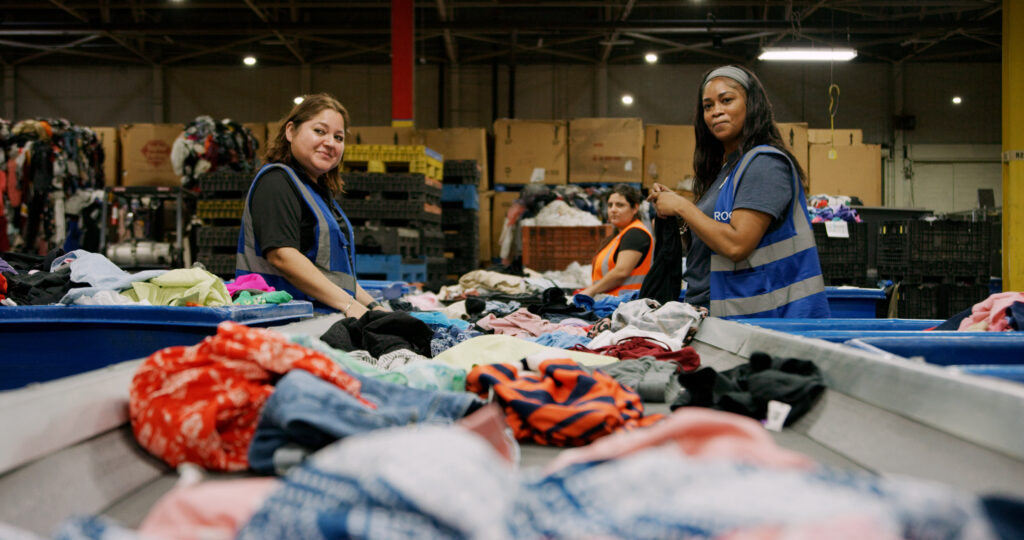
When textiles do not sell in standard retail environments, GCNA sorts textiles by quality, condition, and seasonality to recover remaining value through responsible end markets.
GNCA is committed to building a more sustainable future by finding innovative ways to recover, reuse, and maximize the value of donated materials, while supporting the communities we serve.
Approximately 50% of donated goods do not sell in traditional retail environments. To address this challenge and move beyond the conventional “collect, sell, salvage” model, GCNA implemented a textile sorting and grading system in 2017.
The GCNA Textile Grading Model provides a standardized, scalable approach to textile grading for partners across the Goodwill network. The model evaluates textiles based on quality, condition, and seasonality, ensuring each item is directed to the most appropriate and value-driven market.
GCNA support services enables Goodwill organizations to unlock greater material value, build internal grading expertise, and advance broader circular economy goals. Goodwill partners receive support from GCNA, including:
As part of GCNA’s efforts to identify responsible, alternative end markets, we’ve established a Circular Fashion & Textile Innovation focus area centered on data collection and material insight. This work helps us better understand circularity options for textiles that are not considered quality or condition for traditional reuse.
To support this, we collaborate with leading technology providers that enable advanced identification, sortation, and traceability:

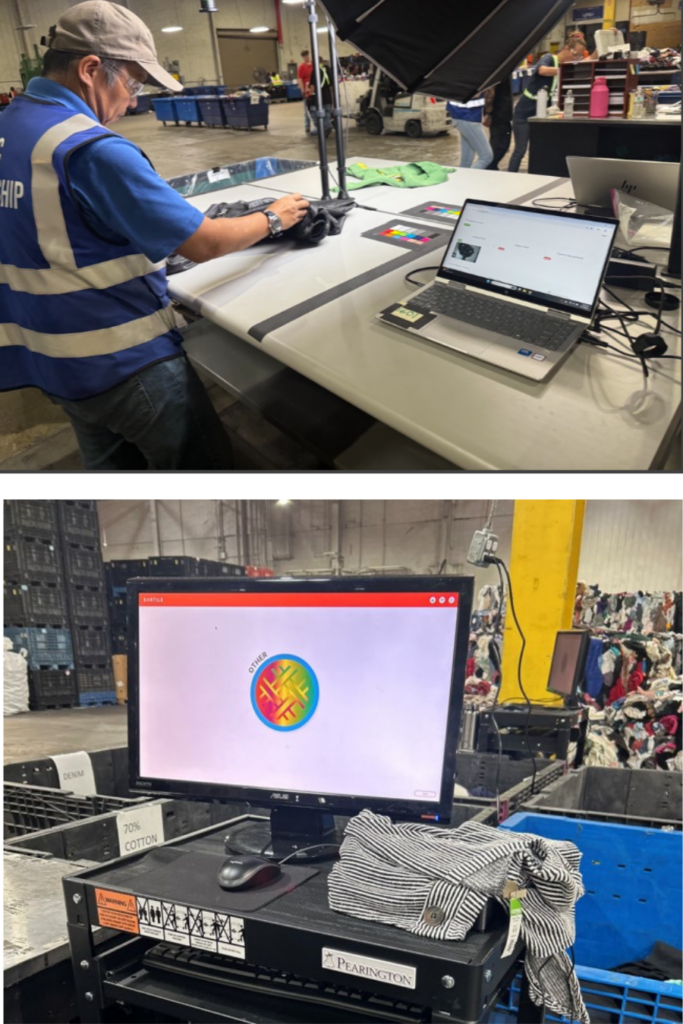
Sortile’s textile-scanning technology identifies and records fiber composition, allowing us to track repair needs, enable accurate sorting, and support proper next-life uses of garments.
Refiberd’s AI technology includes the use of two types of cameras and AI software designed to complement manual grading by accelerating and scaling textile evaluation. These tools will help determine reuse eligibility, detect textiles suitable for repair, and identify materials for recycling pathways.
The implementation of Refiberd technology is funded through the Arizona Department of Environmental Quality’s Recycling Grant Awards – grants that support the advancement of circular economy efforts across the state of Arizona. Read more about it.
Together, these partnerships enhance decision-making, maximize material recovery, and accelerate progress toward a more circular textile system.

Together, Goodwill of Central and Northern Arizona (GCNA) and Industrial Sewing and Innovation Center (ISAIC) are designing a scalable pilot to establish a repair pathway for defective or discarded post-consumer apparel. By combining GCNA’s expertise in collection, sorting, and resale with ISAIC’s training capabilities, the program creates an efficient, repeatable model that diverts textiles from destruction or landfill while advancing workforce development and circular economy goals.
We recognize that success depends on building strong community partnerships and learning from the successes of others. GCNA is forming collaborations grounded in shared values and a shared vision, enabling us to work collectively toward a common mission. That’s why strategic partnerships are established as their own focus area—while also remaining embedded across all other initiatives highlighted.
GCNA’s commitment to collaboration is reflected in several local strategic partnerships, including:

Did you know less than 1% of cloth fiber products are made from recycled materials?
Reju, a materials regeneration company, is dedicated to changing that by creating innovative solutions for recycling polyester textiles. In an exciting move, Reju is collaborating with Goodwill Industries International (GII) and WM to collect and resell or remanufacture discarded textiles into new fabric materials.
“Goodwill has been a leader in sustainability for over a century, and we are proud to be a part of the solution for advancing textile recycling.” – Beth Forsberg, SVP of Sustainability, Goodwill of Central and Northern Arizona
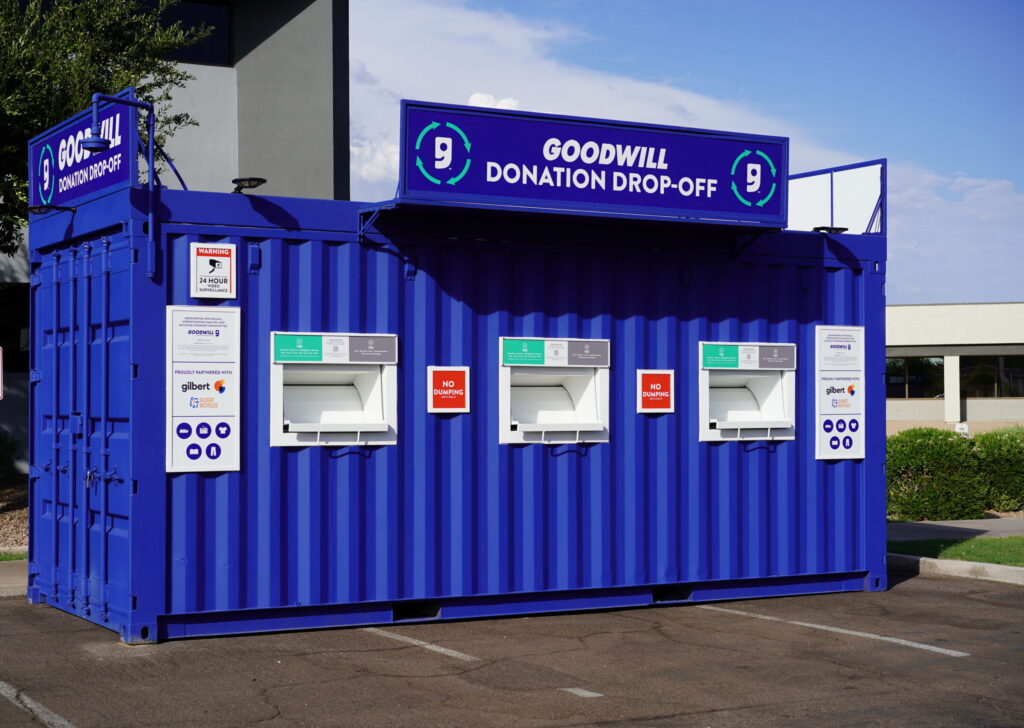
In September 2025, Goodwill launched Arizona’s first remotely-monitored donation containers in the Town of Gilbert. The containers feature easy-to-use donation chutes, offering simple and convenient 24/7 donation access to nearby communities.
Onboard software tracks the volume of donated goods, sending alerts near capacity for quick donation collection. Containers are managed by Goodwill, offering reliable data for municipalities and organizations committed to sustainability and waste diversion.
These redesigned donation containers use upcycled shipping containers and solar power. They are secure, autonomous, and versatile, allowing placement anywhere without grid power. Their flexibility facilitates easy collection and reuse of goods, extending the life cycle of materials and promoting a circular economy through reuse and recycling.
We are proud to join the conversation in sustainability and circularity, sharing how we are making a positive difference and partnering with like-minded organizations. Goodwill SVP & Chief Sustainability Officer Beth Forsberg has contributed and participated in panel discussions at the following recent events.


Goodwill has been an expert in material collection since its founding in 1902. Starting in 2017, that expertise has expanded to include large-scale sorting and grading, helping ensure that donated items are reused, recycled, or aligned with a responsible end market.
As Extended Producer Responsibilities (EPR) policies expand across the country, Goodwill is unique positioned to maximize material collection, sortation, and reuse through:
SB 707: The Responsible Textile Recovery Act of 2024
SB 54: Plastic Pollution Prevention and Packaging Producer Responsibility Act
Check out this recent article highlighting a fellow Goodwill organization supporting the collection, reuse, and regeneration of textiles as the first regeneration hub in the United States. Reju and Goodwill of the Finger Lakes Celebrate Rochester as a Hub for Textile-To-Textile Circularity
Beth Forsberg, SVP & Chief Sustainability Officer at Goodwill of Central and Northern Arizona, joined an episode of Recycled Content with guest host Maite Quinn, President of Re-Colab and Resource Recycling, Inc., to talk about sustainability in the textile industry. Listen to the podcast for free here.
STN highlights Arizona leaders who are finding solutions to growing community challenges, naming Goodwill of Central and Northern Arizona among them.
From heat relief to AI, Arizona leaders focus on community solutions
Goodwill of Central and Northern Arizona’s own Chief Sustainability Officer, Beth Forsberg, is helping guide the sustainability conversation as a Steering Committee member of the Textile Recovery Summit.
The Summit will be co-located with the Plastics Recycling Conference and the Resource Recycling Conference, bringing textile recovery programming to a shared stage with the broader materials management industry. Priority topics under discussion include state-level EPR implementation, chemical recycling and advanced processing, and the global trade dynamics facing secondhand textiles.
We can’t do this without you. The more goods that are donated to Goodwill, the better understanding we have of what is in our waste streams, and once we understand what we’re dealing with, we can innovate and find new solutions to revitalize the reduce, reuse, recycle model!
Help support the planet and empower your local community – find a store or donation center near you and donate your gently used goods today!
Amazing things are always happening at Goodwill of Central and Northern Arizona! From daily specials to job training events, explore our calendar of events to discover what’s going on.